Residential Fire Damage: How to Mitigate First, Then Rebuild
Residential Fire Damage: How to Mitigate First, Then Rebuild
Residential fire damage is really two projects stacked on top of each other. The first one is mitigation — stopping the damage from getting worse in the days after the fire is out. The second is the rebuild — framing, systems, finishes, inspections. People lose months because they treat it as one job and wait for the insurance check before drying the building out. Here is the order the work actually happens in, and where owners get stuck.
The short version
- Water from firefighting usually causes more spread than the fire itself. Drying starts before anyone talks about design.
- Mitigation is emergency work. Most policies cover it as a duty you owe the insurer, not a choice.
- Smoke and soot travel through the whole house. Damage shows up in rooms the flames never touched.
- The insurance scope of work — usually written in Xactimate — becomes the budget. Read it line by line before you agree to it.
- Demolition tells the truth. What you find behind the drywall changes the number.
- Structural repairs after a fire almost always need a permit and often an engineer's letter.
- Rebuild sequencing is the same as any renovation: rough-in, inspect, close up, finish.
- Do not sign a rebuild contract that is priced off a scope you have not read.
What to do in the first 72 hours after a house fire
Get the fire report. Call the insurer and open the claim. Ask for the claim number, the adjuster's name, and what the policy pays for emergency mitigation.
Then board up, tarp the roof, kill the power to wet circuits, and start drying. Standing water plus Georgia humidity means mold in a matter of days. The restoration industry works to the IICRC S700 standard for fire and smoke restoration — ask any mitigation company whether their techs are certified to it.
Photograph everything before it moves. Every room, every wall, open every closet. That photo set is your evidence when the scope is written.
Mitigation vs. restoration vs. rebuild
These three words get used interchangeably by people who should know better. They are different jobs, often different companies, and different lines on your claim.
| Stage | What it is | Who typically does it | When it happens |
|---|---|---|---|
| Mitigation | Board-up, tarp, water extraction, drying, air scrubbing | Emergency restoration contractor | Hours to days after the fire |
| Restoration / cleanup | Soot removal, deodorizing, HEPA vacuuming, contents cleaning, selective demo | Restoration contractor | After drying, before scope is final |
| Rebuild | Framing, MEP, drywall, trim, flooring, paint, inspections | General contractor | After the insurance scope is agreed |
A note on smoke: soot is acidic. It etches glass, pits metal, and gets into HVAC ductwork and wall cavities. Deodorizing a house is not spraying air freshener — it is cleaning surfaces, sealing what cannot be cleaned, and replacing porous materials that hold odor.
What demolition actually exposes
Demo is where the estimate meets reality. Charred framing that looked salvageable from the room side often has to come out. Wiring in an affected bay gets replaced, not tested.
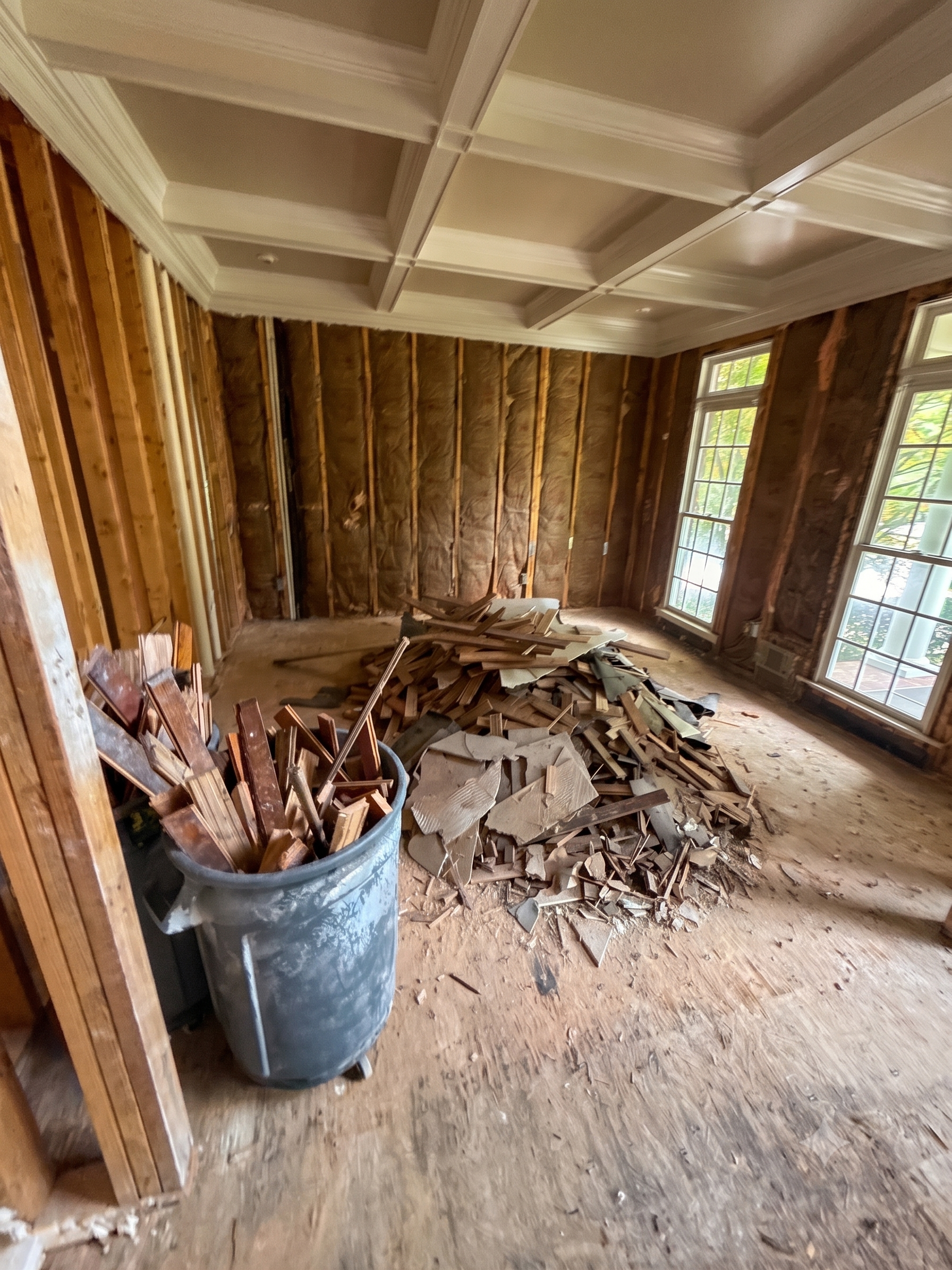 Room stripped to the studs with the ceiling left intact, demoed flooring and drywall piled for removal
Sometimes a ceiling, a fireplace surround, or built-in cabinetry survives and is worth protecting. Protecting it costs labor. Replacing it costs more.
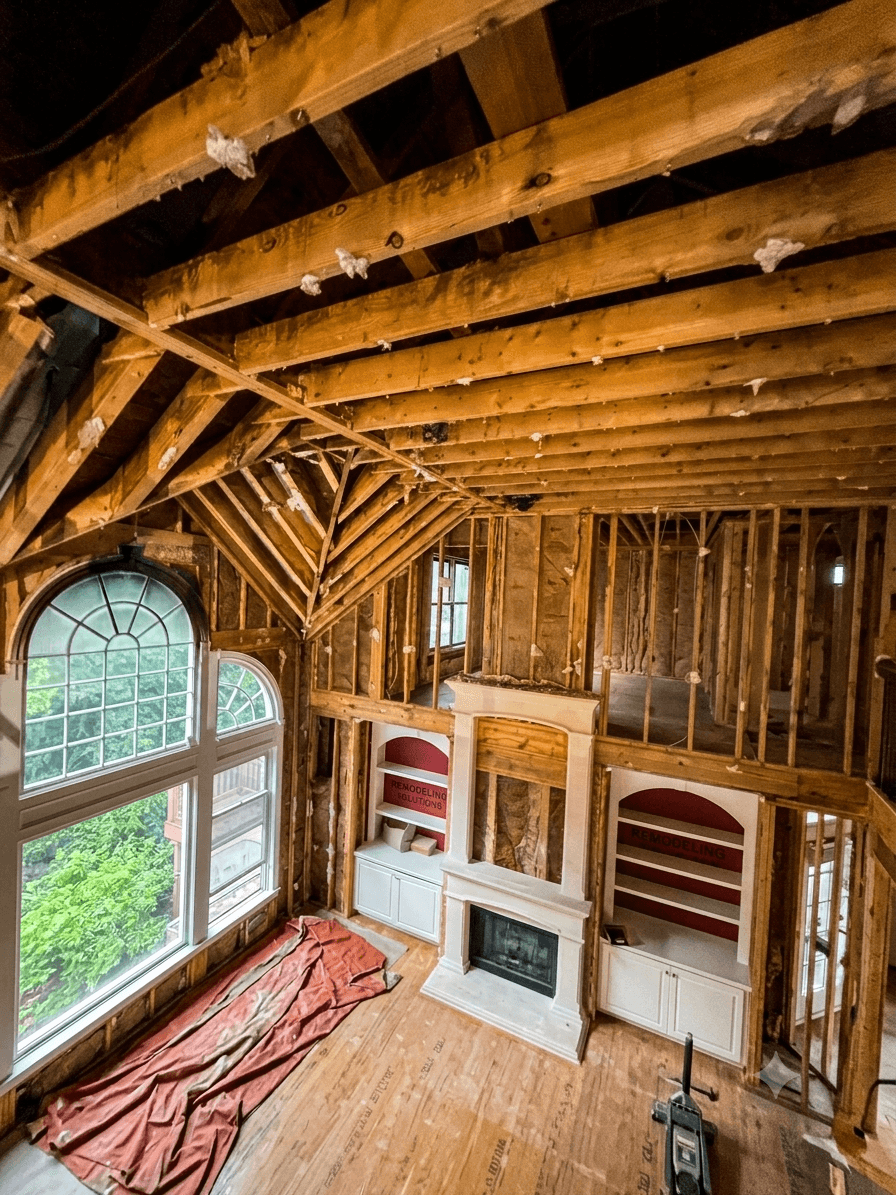
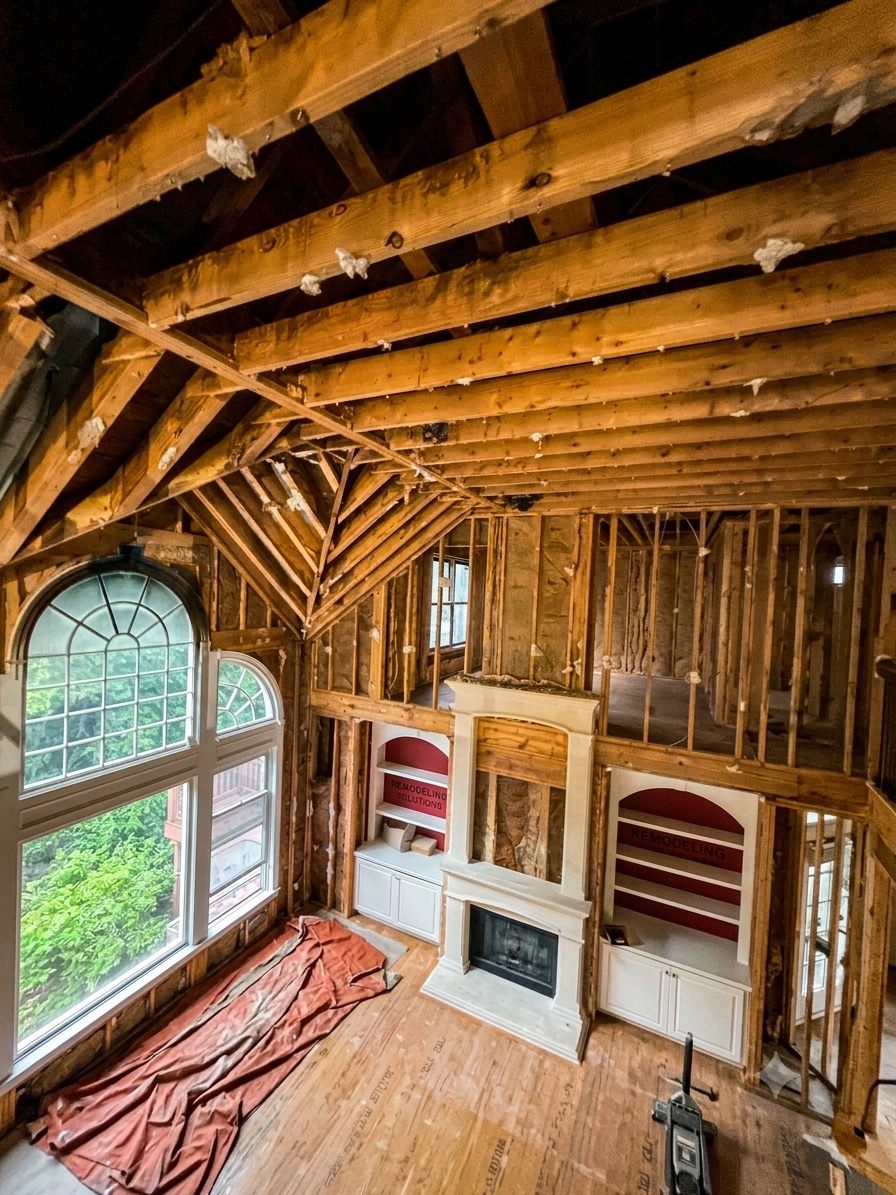 Two-story space gutted to framing and roof rafters with the fireplace and built-ins protected in place
Demolition is not destruction. It is the first honest estimate you will get.
If you are staring at a scope you do not understand, get a contractor to walk the building with you before you sign anything.
Rebuild after a house fire: the sequence
| Phase | What happens | What has to finish first |
|---|---|---|
| 1. Scope agreed | Insurer scope reconciled with contractor's estimate | Mitigation and demo |
| 2. Permit | Drawings or engineer letter submitted, permit issued | Scope agreed |
| 3. Structural | Framing repair, sheathing, roof | Permit |
| 4. Rough-in | Electrical, plumbing, HVAC; rough inspections pass | Framing complete |
| 5. Close-in | Insulation, drywall, tape and finish | Rough inspections |
| 6. Finishes | Trim, flooring, paint, fixtures, final inspection | Drywall |
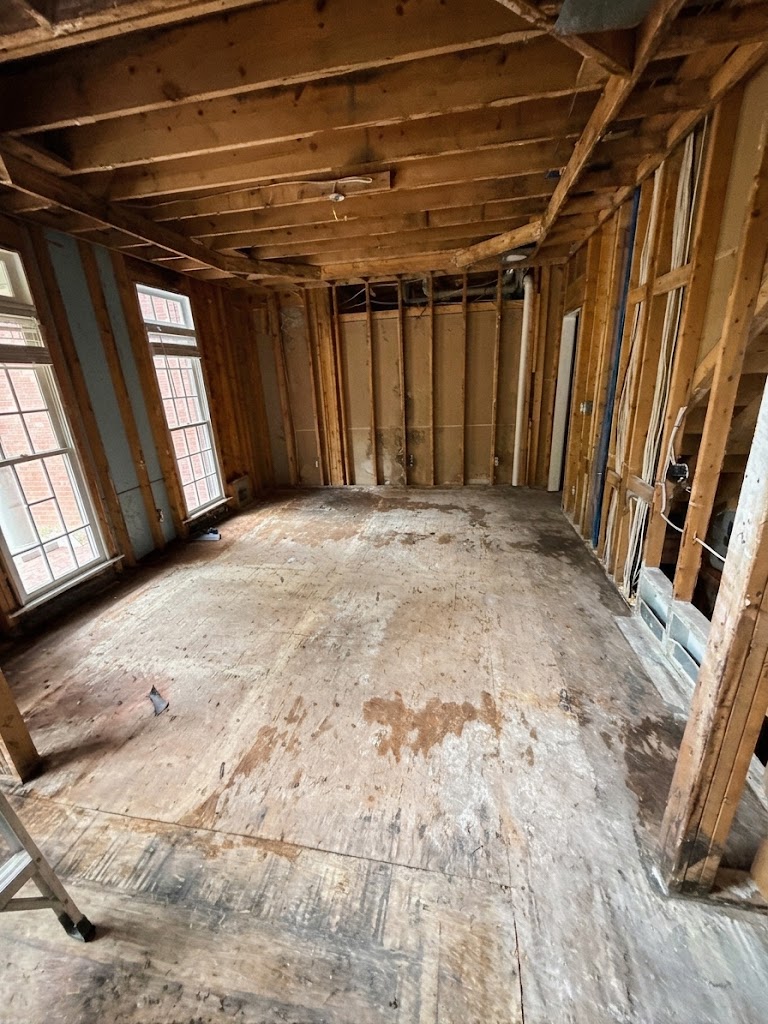 Deeper gut showing exposed ceiling joists, stained subfloor, and open framing bays ready for new rough-in
Skipping a rough inspection to save a week costs you a month. Inspectors will make you open the wall back up.
Where this goes wrong
- Waiting for the insurance check before drying. The damage compounds daily. Mitigation is supposed to start first.
- Signing the restoration company's rebuild contract without reading the scope. Mitigation and rebuild do not have to be the same company.
- Not comparing the adjuster's scope to a contractor's estimate. If line items are missing, they are missing from your budget too.
- Ignoring the difference between actual cash value and replacement cost. ACV pays depreciated value up front. Replacement cost is released after the work is done and documented.
- No allowance for what demo finds. Fire damage hides. Build a contingency into the schedule and the money.
- Moving contents back in before deodorizing is verified. Odor comes back in the first humid week.
FAQ
How long does it take to rebuild a house after a fire?
It depends on how much structure was lost and how fast the insurance scope is agreed. The scope negotiation is usually the longest single delay, not the construction. Permit review adds time on top of that.
Does insurance pay for smoke damage in rooms that did not burn?
Usually yes, if the policy covers the fire. Smoke and soot are direct results of the covered loss. You have to document it, room by room, with photos and a written inspection. Undocumented rooms tend to fall off the scope.
Can I use my own contractor instead of the insurer's preferred vendor?
In most cases yes. Preferred vendor programs are a convenience, not a requirement. Confirm it in your policy language and with your adjuster in writing before you hire anyone.
Do I need a permit to repair fire damage?
Structural repair, electrical, plumbing, and HVAC work almost always require permits. Cosmetic cleaning usually does not. Your local building department makes the call, and the fire report often triggers extra review.
What is a scope of work in an insurance claim?
It is the itemized list of every repair the insurer agrees to pay for, with quantities and unit prices. It is the budget. If a line is not on it, no one is paying for it unless you get a supplement approved.
If the damaged building is commercial, call
Mark Allan Contracting is a commercial general contractor. Fire, water, and storm damage in an office, shop, warehouse, or restaurant falls under building repair and often turns into a full tenant improvement or office renovation once walls are open. We work in Georgia, Tennessee, Alabama, and South Carolina on projects from $50K to $500K.
Call (404) 724-8709. The first call takes about fifteen minutes: you describe the space and what happened, we tell you whether the job fits what we do, and we set a walkthrough so you get a real scope instead of a guess. Do it before the insurer's scope is finalized — that is when your input still changes the number.