Emergency Roof Tarping After Fire or Storm Damage: Why the First 24 Hours Decide Your Repair Bill
Emergency Roof Tarping After Fire or Storm Damage: Why the First 24 Hours Decide Your Repair Bill
The fire is out. The trucks are gone. There is a hole in your roof and the sky is showing through it. Every hour that hole stays open, the loss keeps growing — into units, ceilings, drywall, insulation, and electrical that the fire never touched. Emergency roof tarping is the cheapest work anyone will do on your building all year, and it only works if it happens fast. Here is how a same-day response actually goes, and what waiting costs.
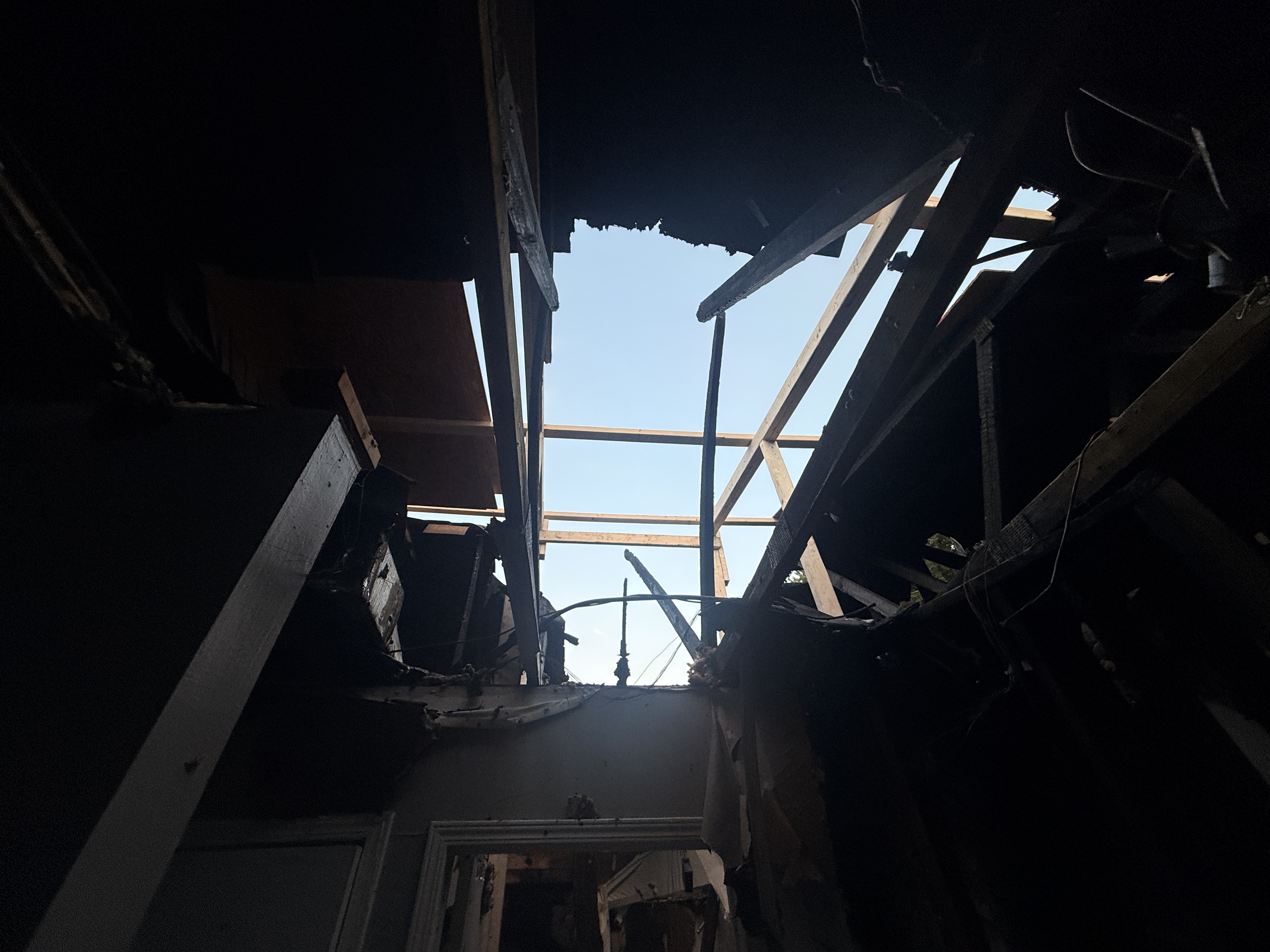 Fire-damaged roof framing open to the sky above a second-floor hallway
The short version
- Fire and storm damage stop. Water damage does not — it keeps spreading until the building is closed up.
- A tarp is temporary protection, not a repair. Its job is to hold the loss where it is.
- Same-day matters most in Georgia, where an afternoon thunderstorm can arrive with almost no warning.
- Charred framing, burned wiring, and soaked insulation all get worse when they get wet again.
- Your insurance policy almost certainly requires you to protect the property from further damage. Not doing it can hurt your claim.
- Photograph everything before and after the tarp goes on. Those photos are part of your claim file.
- A tarp buys you weeks, not months. Use that time for scope, engineering, and permits.
- One call and a crew on site in a couple of hours is the difference between drying out one unit and gutting four.
What emergency roof tarping actually is
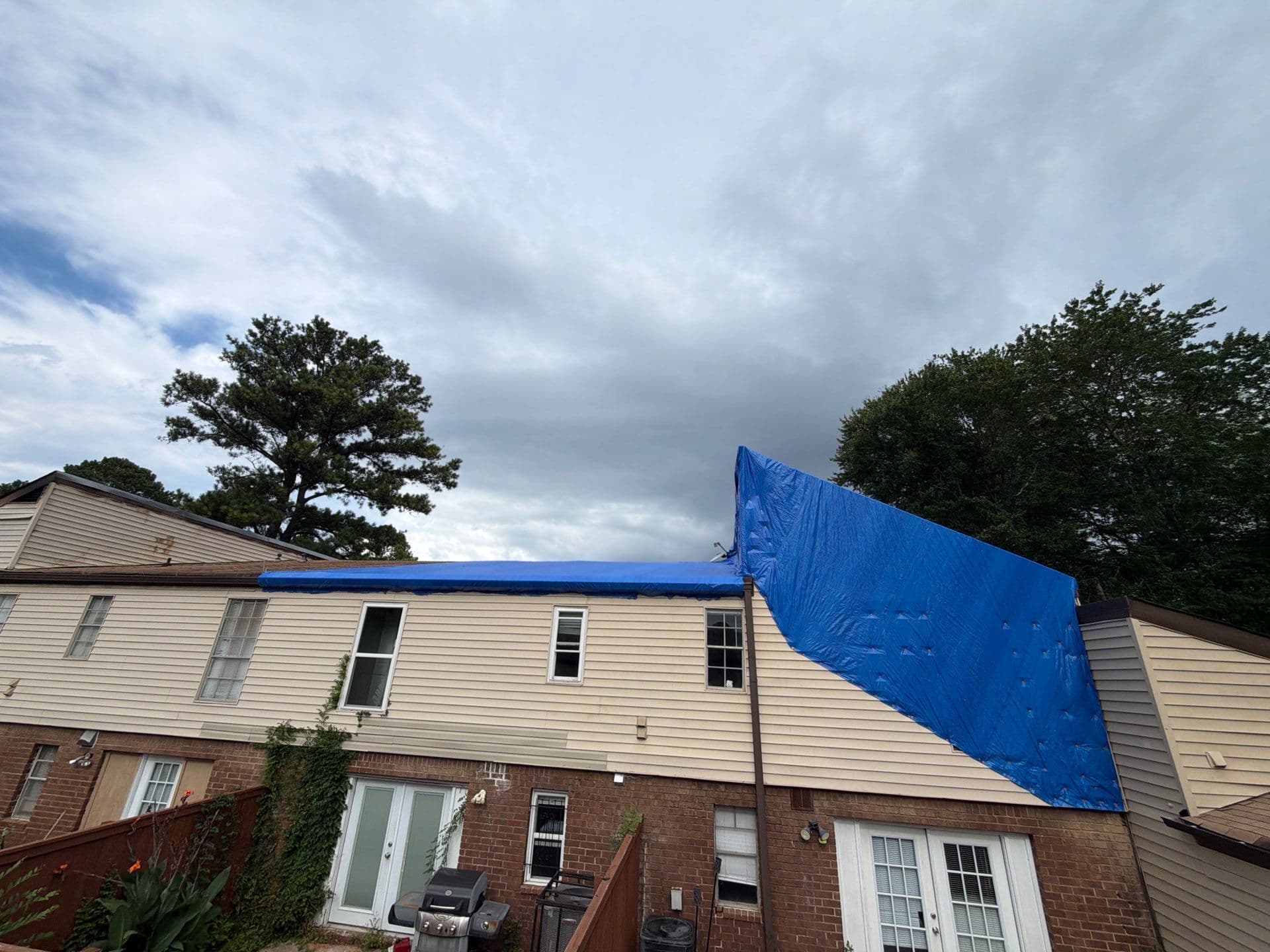
A tarp is a temporary roof. Heavy poly sheeting is run over the opening, lapped past the damage on all sides, and fastened down with furring strips — thin wood strips screwed through the tarp into solid decking or framing so wind can't peel it. Done right, it sheds water like a roof. Done fast and sloppy, it becomes a funnel that channels water into one spot.
The crew is not fixing anything. They are closing the building.
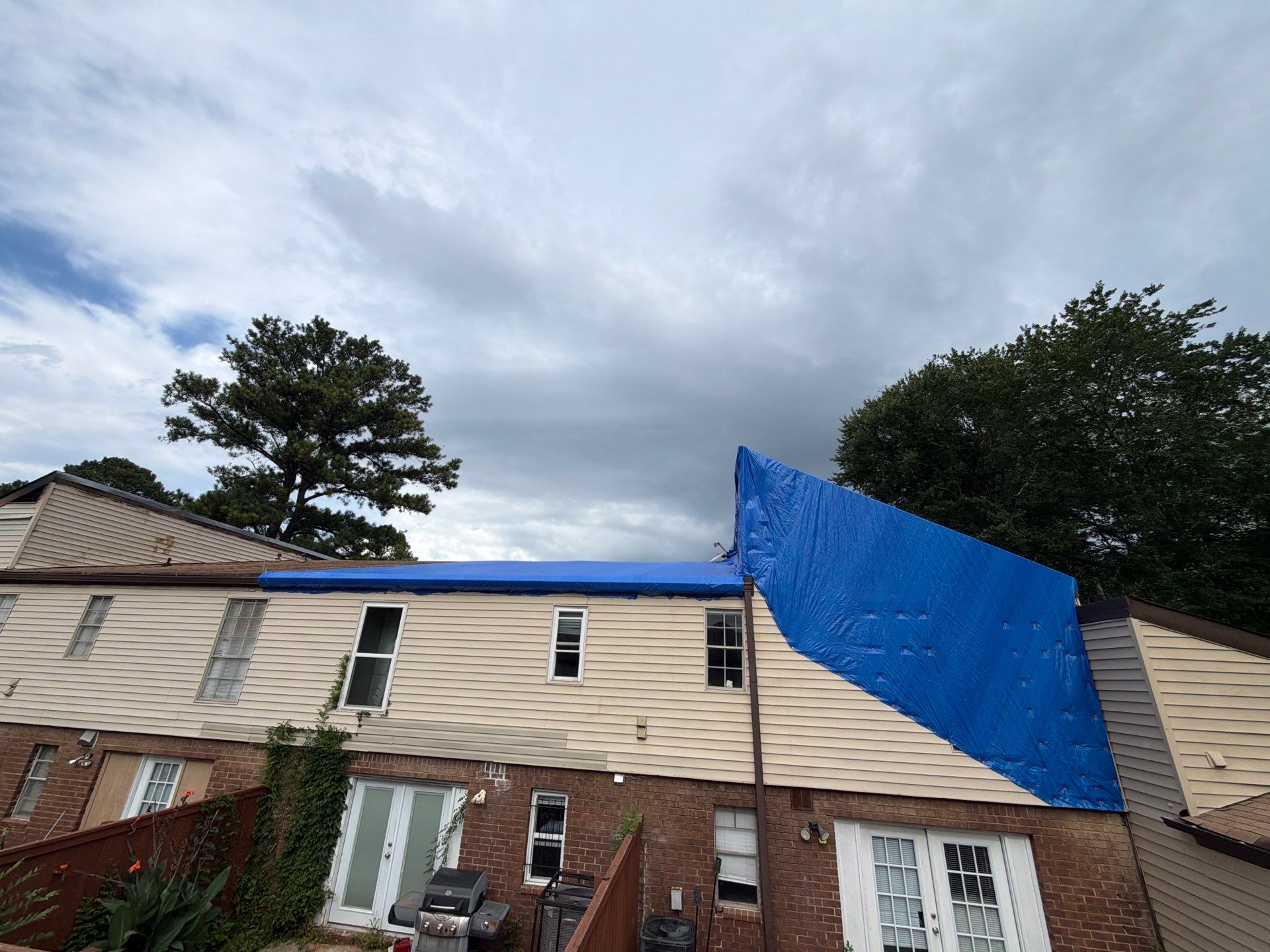 Blue tarp secured over a fire-damaged roof section on a multi-unit building
That distinction matters when you talk to your insurance adjuster. Tarping is usually treated as mitigation — the work you do to stop the loss from growing. The permanent repair is a separate scope, separately priced, and it takes longer to define.
Why speed matters more than you think
Here is what happens inside a building with an open roof.
Water enters at the hole and travels sideways along the top of the ceiling drywall until it finds a low point. It drops there. Now you have damage in a room that had none. Insulation soaks and stays soaked — fiberglass holds water against wood framing for days. Charred lumber that might have been cleaned and sealed starts to soften. Electrical that survived the fire gets wet and has to be replaced anyway.
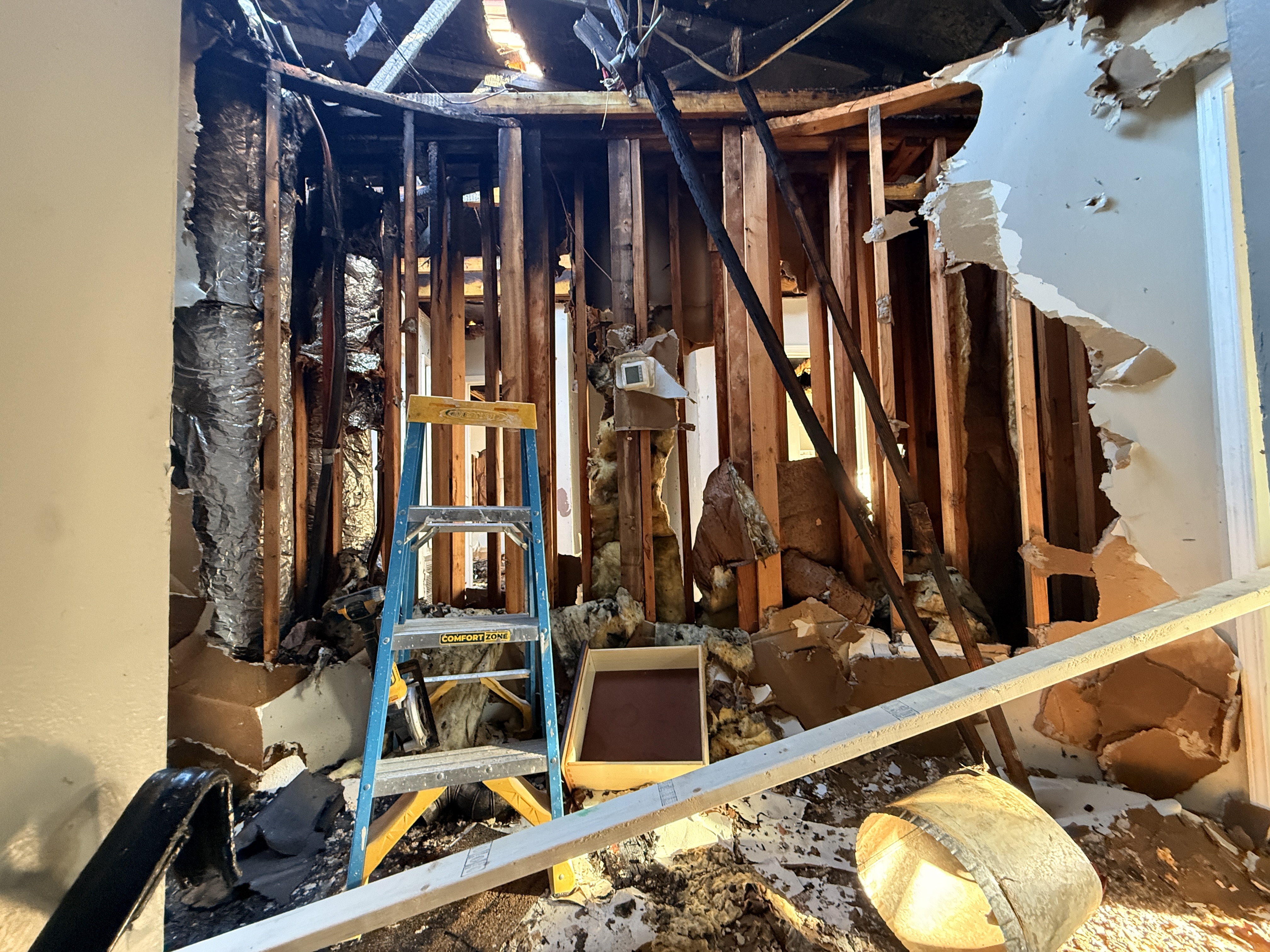 Interior wall opened to studs after fire, with wet insulation and burned framing above
And then there's mold. In a humid Southeast summer, wet organic material starts growing quickly.
The fire decides how much you lost. The tarp decides how much more you lose.
Add one more factor. Multi-tenant buildings and condo associations have a boundary problem. Water does not respect unit lines. A single open section over a shared roof can put four owners into a claim instead of one, and now you have four adjusters, four contents lists, and four people calling the board every day.
What a same-day response looks like
A real emergency response runs in a rough order. Times vary with distance, weather, and whether the fire department has released the structure.
| Stage | What happens | Typical window |
|---|---|---|
| Call received | Address, access, scope of opening, who has authority to sign | Minutes |
| Crew dispatched | Materials loaded — poly, furring, fasteners, ladders, fall gear | [VERIFY: MAC standard dispatch window for emergency calls] |
| On site | Walk the exterior, assess whether the deck can be walked on safely | Same day |
| Safety call | If framing is unstable, tarp gets anchored from outside the damage zone only | Same day |
| Tarp installed | Sheeting lapped past damage, strips screwed down, edges sealed | [VERIFY: typical tarp install duration for a single roof section] |
| Documentation | Photos before, during, after; written note of what was covered | Same visit |
We were called to a condo association in Decatur after a fire opened up a roof section. Crew was on site in about two hours and the tarp was on that same day, before the next weather came through.
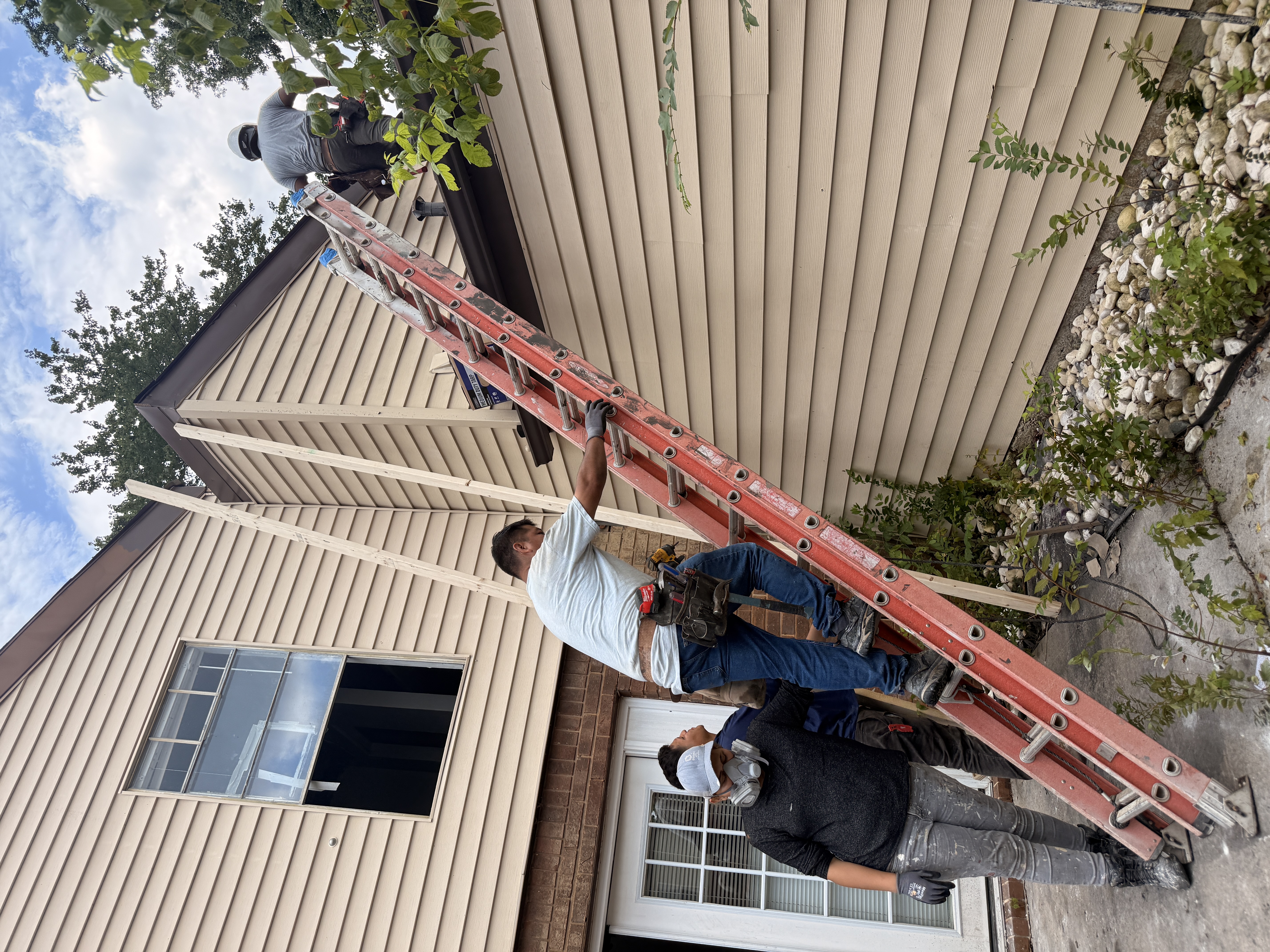 Crew setting ladders and staging material to tarp a fire-damaged roof
If you're staring at an open roof right now, stop reading and call — the assessment happens on the phone and the crew loads while we talk.
What the crew has to check before anyone goes up
A burned roof is not a safe roof. Framing that looks solid can have lost most of its strength.
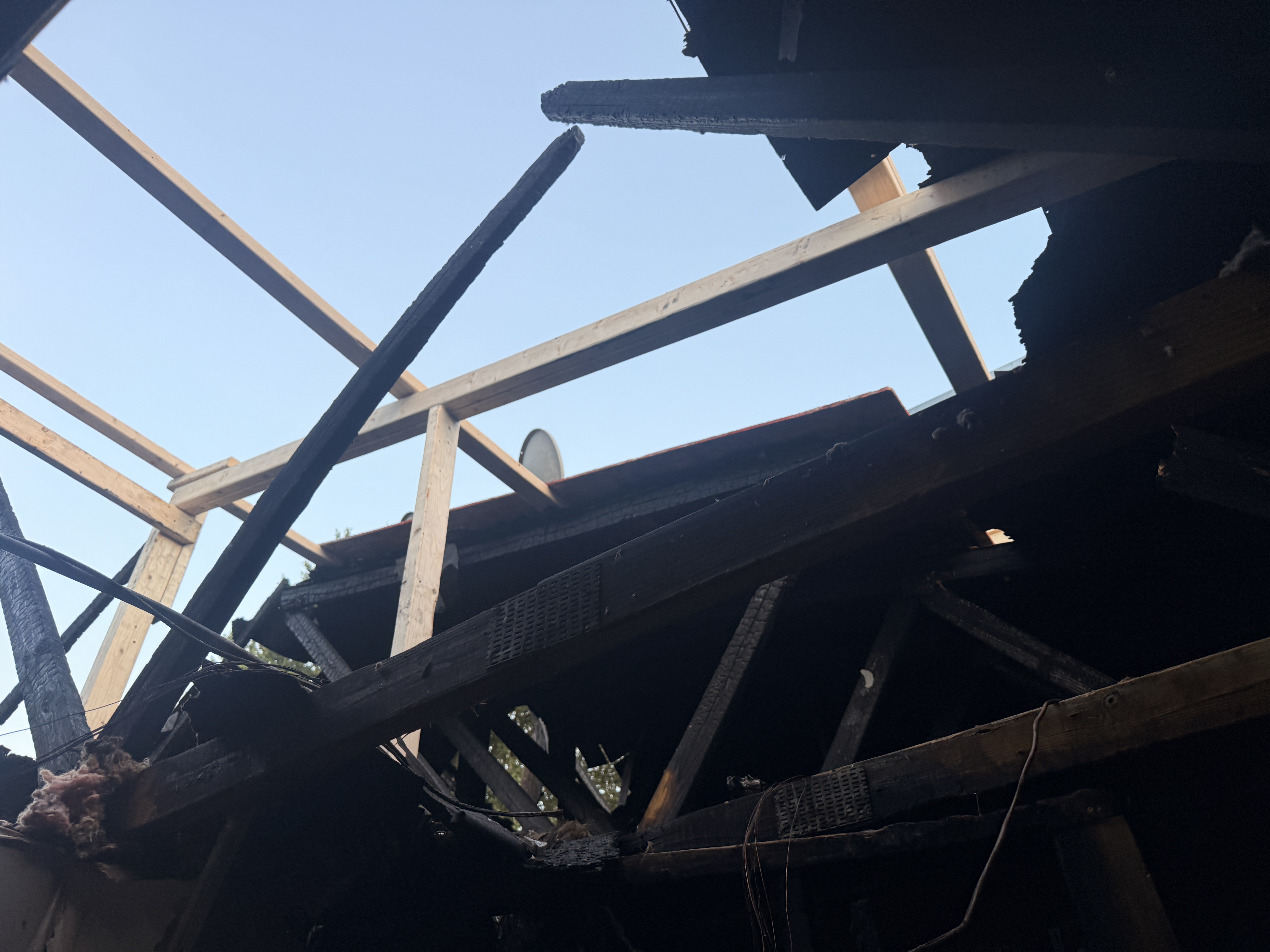 Charred rafters and trusses with only partial replacement framing in place
Before a tarp goes on, someone has to answer three questions:
- Can the deck hold weight? If the answer is no, the tarp gets anchored to sound structure outside the burn area and spanned across.
- Is the power off? Burned wiring in the attic is a live hazard until the utility or an electrician confirms otherwise.
- Is anything hanging? Loose sheathing, collapsed trusses, and hanging fixtures come down first or get secured.
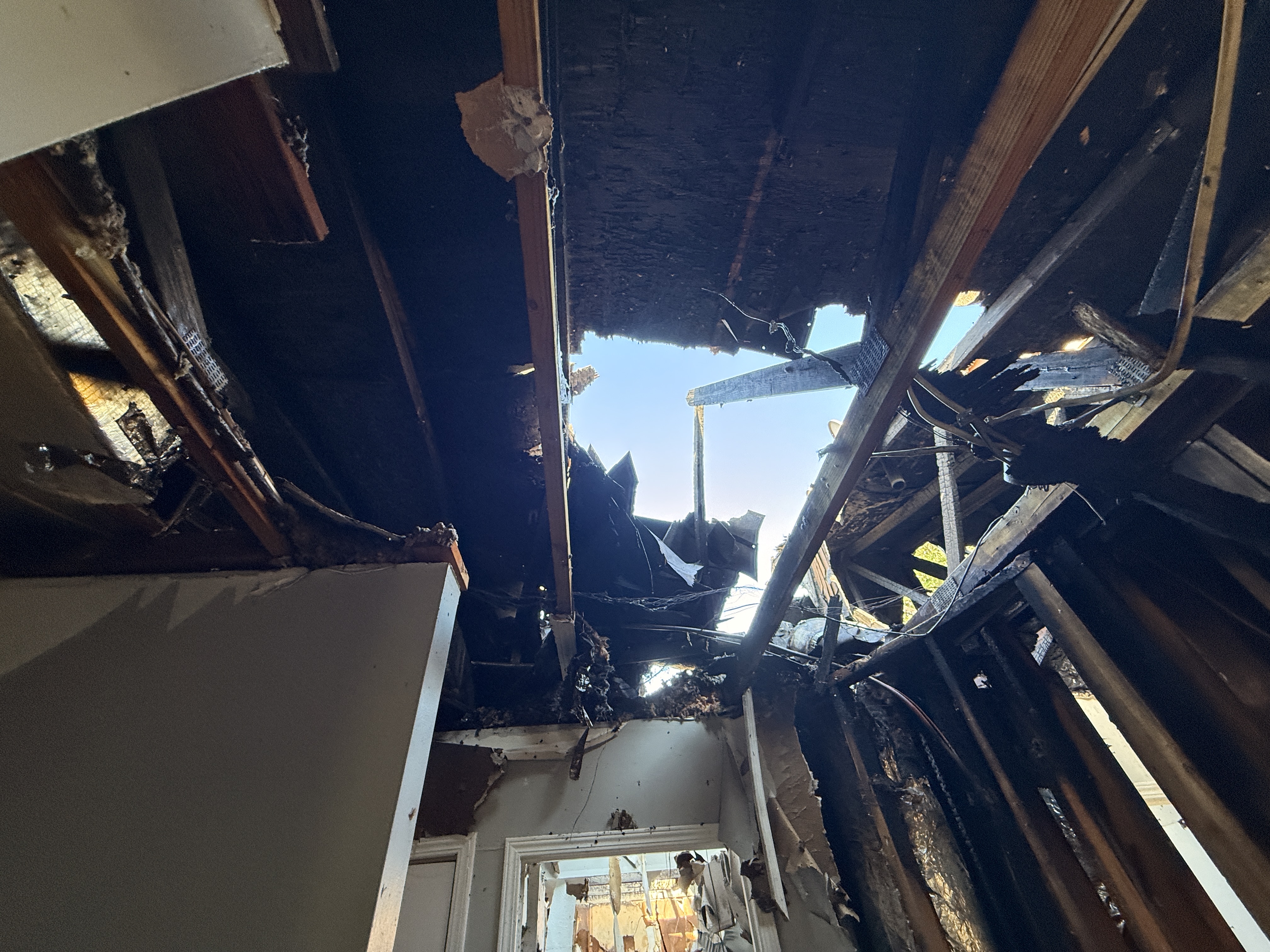 Collapsed and burned roof structure over a second-floor room
This is also where the permanent scope starts to form. What the crew sees from the ladder — how far the char runs, whether the trusses are engineered or stick-framed, whether the damage crossed a firewall — feeds directly into the building repair estimate that comes later.
What tarping costs, and how it fits your claim
Emergency mitigation is usually billed separately from the repair. It is small money against the loss.
Most commercial and association property policies include a duty to protect the property from further damage. If you skip it and the building takes on water for a week, the carrier can argue the additional damage was avoidable. That's an ugly conversation to have while you're already displaced.
Do three things the day of the loss:
- Photograph the opening from inside and outside before anyone touches it.
- Get the mitigation invoice in writing, separate from the repair proposal.
- Tell your adjuster the tarp is on and send the photos the same day.
Where this goes wrong
Waiting for the adjuster before tarping. Adjusters do not need you to leave the building open. They need documentation. Photograph it, then close it.
Tarping only the visible hole. Water finds the edge. A tarp that stops at the burn line will let water under the lap on the first hard rain. It has to run well past the damage and up-slope.
Using hardware-store tarps and bricks. Grommets tear. Weighted tarps slide. Furring strips screwed into solid wood are what holds through a summer storm.
Assuming the tarp is fine for months. Sun and wind break down poly. Plan to inspect it and expect to replace it if the permanent repair drags.
Letting the board debate it. In an association, the fastest path is one person with authority to approve emergency mitigation. Decide who that is before you need one.
Skipping the interior. If ceilings are already wet, the tarp alone won't dry them. Drying equipment and demo of soaked material usually need to start in parallel.
FAQ
How fast should a roof be tarped after a fire?
Same day, once the fire department releases the structure. Water damage compounds every hour the roof is open, and in the Southeast a storm can show up with little warning. If same day is genuinely impossible, get interior containment and buckets in place and tarp first thing the next morning.
Does insurance pay for emergency roof tarping?
Usually yes, as mitigation, and most policies actually require you to prevent further damage. Keep the tarping invoice separate from the repair proposal and send your adjuster photos the same day.
How long can a tarp stay on a roof?
Weeks, not months. Poly sheeting breaks down under UV and wind, and fasteners work loose. Treat it as a bridge to a permanent repair, and inspect it after every significant storm. If your repair scope is going to take longer, budget for re-tarping.
Can you tarp a roof if the framing is burned through?
Yes, but not by walking on it. The tarp gets anchored to sound structure outside the damaged area and spanned over the opening. Sometimes temporary bracing goes in first. A crew that walks onto charred decking to save time is a crew you should send home.
Who authorizes emergency work for a condo association?
Whoever your governing documents say — often the board president or the property manager under an emergency spending threshold. Sort that out before a loss happens. Hunting for a signature at 6 p.m. on a Friday is how a roof stays open through a weekend of rain.
What happens after the tarp goes on?
Drying and demolition of wet material, then a real scope of the permanent repair. That means opening walls and ceilings to see how far the damage runs, pricing the rebuild, and pulling permits.
Get it closed today
If your roof is open, the clock is running and the weather does not care about your schedule. Call (404) 724-8709. On that call we'll ask for the address, how bad the opening is, whether power is off, and who can approve the work — about five minutes. If it's within reach, a crew loads materials and heads out while we're still talking, and you'll get photos of the finished tarp before the day is over.
The permanent repair can wait a week. The tarp cannot.